

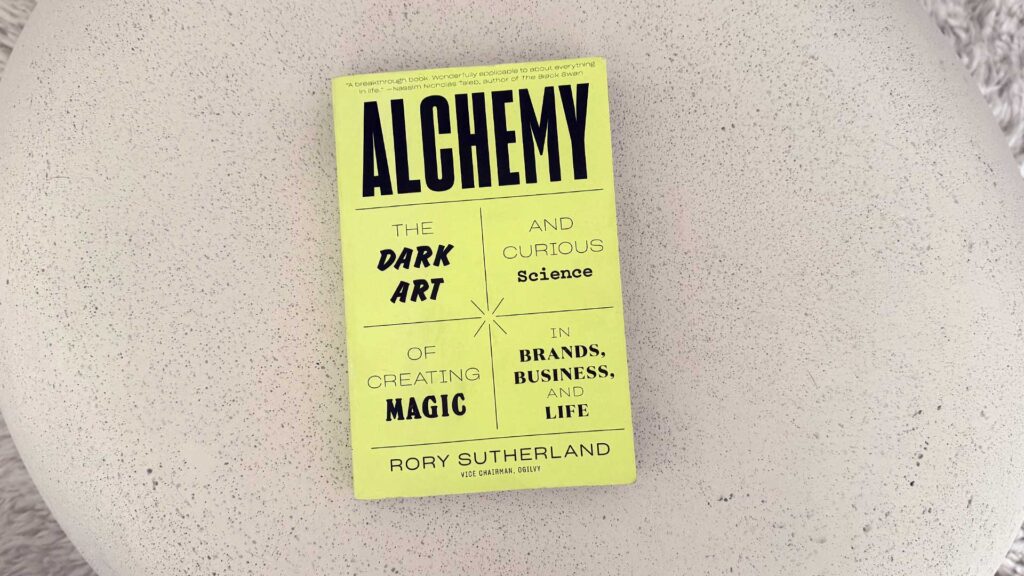
Why embracing the irrational might be the smartest thing a marketer can do.
Rory Sutherland has spent his career chasing what most of us overlook — the irrational, the emotional, the seemingly illogical quirks that make humans endlessly unpredictable. As Vice Chairman of Ogilvy UK, he’s built his reputation on the idea that magic still matters in marketing. His book Alchemy: The Surprising Power of Ideas That Don’t Make Sense is a reminder that sometimes the best ideas are the ones that refuse to fit inside a spreadsheet.
I may be biased: my first job was as a copywriter at Ogilvy. Perhaps that’s why Rory’s thinking feels like coming home — not to a place, but to a philosophy. Ogilvy taught generations of creatives to combine discipline and daring, logic, and imagination. Alchemy captures that balance perfectly. It’s a love letter to the irrational, written from inside one of the most rationally structured industries in the world.
1. Logic isn’t everything
Marketers love reason. We rely on data, segmentation, and performance metrics to make sense of our audiences. But humans are gloriously resistant to reason. They buy feelings, not facts. They fall for context, not comparisons.
Sutherland puts it beautifully: “The opposite of a good idea can also be a good idea.” This is more than paradox — it’s permission. It means that creativity doesn’t need to obey the laws of efficiency to be effective. Some ideas work precisely because they are absurd — because they surprise, delight, and cut through the noise of optimization.
At Ogilvy, I learned that copywriting wasn’t just about words; it was about rhythm, psychology, timing. The emotional pulse behind an idea. Alchemy is a manifesto for rediscovering that pulse.
2. The behavioral lens: why sense often makes nonsense
The beauty of Alchemy lies in how it reframes what marketers already know but rarely articulate: people don’t think in straight lines. Behavioral science has given us language for this — biases, heuristics, choice architecture — but Sutherland translates the theory into something deeply human.
We don’t buy the cheapest coffee; we buy the one that tells the right story. We don’t choose the fastest route; we choose the one that feels smoother. Red Bull sells energy by selling audacity. Häagen-Dazs sells quality by selling vowels — the name was invented in the Bronx, but the Scandinavian sound made it feel like imported luxury.
What Alchemy teaches is not manipulation but empathy: understanding that perception is reality, and that sometimes the most generous thing a brand can do is to respect the irrational ways people make sense of the world.
3. Creativity as hypothesis
Rory sees creativity as a form of applied curiosity. He argues that creative ideas are “magic spells cast in public” — they can’t be proven before they’re tested. That’s a radically freeing notion for any marketer.
Logic validates what already exists. Creativity proposes what could. The difference between a strategist and a magician is evidence; the difference between a magician and a strategist is imagination.
To experiment (truly experiment) is to admit we don’t have all the answers. And in an era obsessed with certainty, that humility becomes its own competitive advantage. Every creative act becomes an act of research.
4. The magic of small things
Sutherland delights in details: the quirks, the copy tweaks, the packaging gestures that seem inconsequential but shift perception entirely. He once said, “If you want to change behavior, sometimes you don’t need to change reality — just the story people tell themselves about it.”
Think of the tiny chocolate on your hotel pillow. The reassuring click of a car door. The satisfying weight of an iPhone box. Each is a form of alchemy — symbolic, sensory, and strategic all at once.
Great marketing doesn’t always need a bigger budget. Sometimes, it just needs a more poetic eye.
5. Why it matters now
We are entering a paradoxical age: the more we automate, the more we crave the human. AI can calculate patterns, but it can’t intuit desire. It can predict outcomes, but it can’t feel surprise.
That’s why Alchemy feels almost prophetic. In a world where logic is being outsourced to machines, Sutherland reminds us that imagination remains our most irreplaceable tool. The irrational becomes not a flaw, but a moat.
Marketers often describe themselves as storytellers, but Alchemy challenges us to be meaning-makers — to see the irrational not as noise, but as signal. Because the future of creativity will not be ruled by who optimizes better, but by who dares to believe in magic longer.
If you haven’t read Alchemy, read it.
If you have, read it again. This time focus on the sentences that make you smile for no logical reason. Those are the ones you’ll return to when data stops inspiring and curiosity begins again.
Tag: @rorysutherland
#MarketingStrategy #BehavioralEconomics #BrandThinking #Creativity #AMASouthFlorida #Ogilvy #Alchemy