

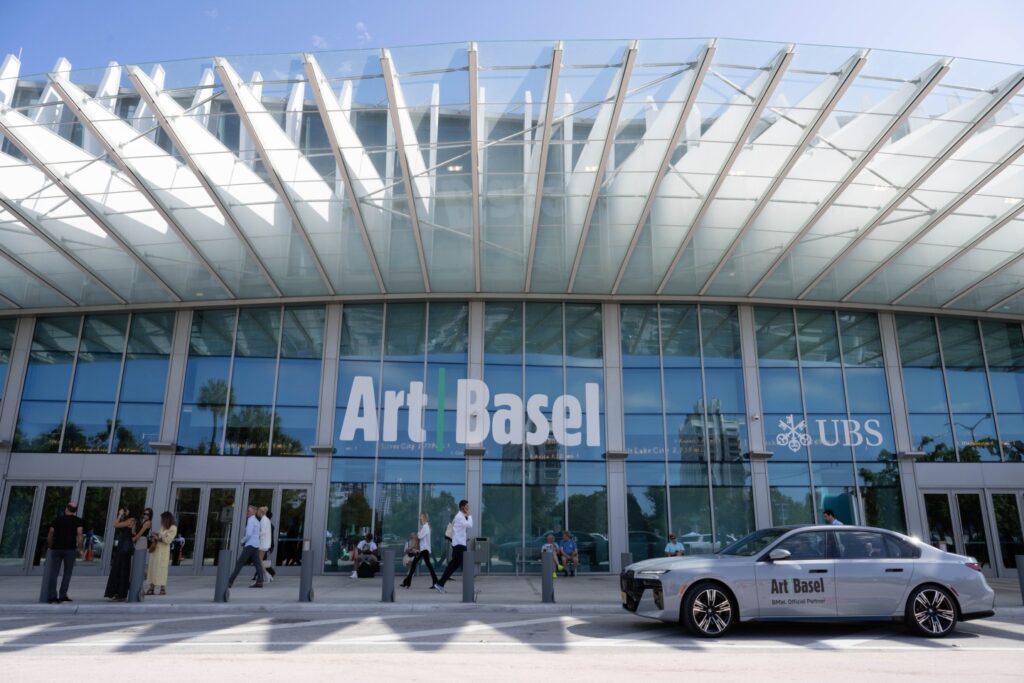
How the event turned Miami into the world’s creative capital for one week a year — and how luxury brands piggyback on its aura.
In early December, Miami stops being a city and becomes a moodboard. Hotel lobbies turn into galleries. Rooftop bars double as fashion runways. The air feels charged — equal parts sea salt and possibility.
I was lucky to experience it last year with VIP tickets, thanks to my friend Sandra (love u amiga) — the perfect host for Basel week. She seems to know every gallerist, every curator, what they showed last year and twenty years before. Following her through the maze of art and sunlight was like joining a living archive of Art Basel itself.
At one point we caught sight of Leonardo DiCaprio — cap low, mask on, but unmistakable. Not so much spotted as absorbed into the scenery. That’s the thing about Art Basel Miami, you’re part of the tableau.
And this is the essence of Art Basel Miami — not just an art fair, but a brand ecosystem. A living network where art, commerce, and cultural capital merge, and where being present is as much an act of storytelling as collecting.
Basel, Hong Kong, and Miami: Three Versions, One Brand
The original fair in Basel is all precision and pedigree — white walls, quiet confidence, and the hum of legacy. It’s a fair of provenance and patience, where collectors move through decades of art history and deals unfold in whispers over polished flutes of champagne.
Hong Kong, on the other hand, vibrates with velocity. It’s where the market meets momentum — skyscraper reflections, collectors in sneakers, and VIP previews that feel like product launches. With 86,000 visitors in 2023 and record-setting sales like a Yayoi Kusama piece fetching $3.5 million on opening day in 2025, it’s the art world’s fastest-moving marketplace.
Then comes Miami — the youngest sibling, the one that decided rules were optional. Sunlight replaces solemnity. Latin rhythm replaces restraint. The fair spills far beyond the Convention Center: onto beaches, rooftops, pop-ups, and pool decks where brands and artists share the same stage.
Miami didn’t just inherit the Art Basel model — it rewrote it. It made art feel like a social sport, where conversation, cocktails, and collaboration happen in the same frame. It layered sociability, spectacle, and brand activation into something uniquely its own. That transformation — from fair to phenomenon — turned Basel into a cultural ritual, where presence itself is part of the art.
The Business of Aura
Every edition of Art Basel functions as both gallery and generator — an art marketplace with the GDP of a small nation. The numbers tell the story. In 2025, Art Basel Switzerland opened with multimillion-dollar transactions, including a David Hockney painting selling for between $13 million and $17 million.
At Art Basel Hong Kong 2023, attendance rebounded to pre-pandemic highs — 86,000 visitors — reaffirming its role as Asia’s cultural stock exchange.
Meanwhile, Art Basel Miami Beach 2024 drew over 75,000 attendees and generated an estimated $547 million in local economic activity — roughly equivalent to hosting a Super Bowl every December. Earlier reports already placed the impact near $500 million before global luxury fully joined the spectacle.
But beyond the numbers lies what Miami sells best — aura. Here, the economy runs on perception. To attend is to align; to show up is to signal. For brands, collectors, and creators alike, Art Basel Miami Beach has become the world’s most glamorous form of attendance marketing — where visibility, proximity, and belonging carry as much currency as art itself.
The Brand Playground
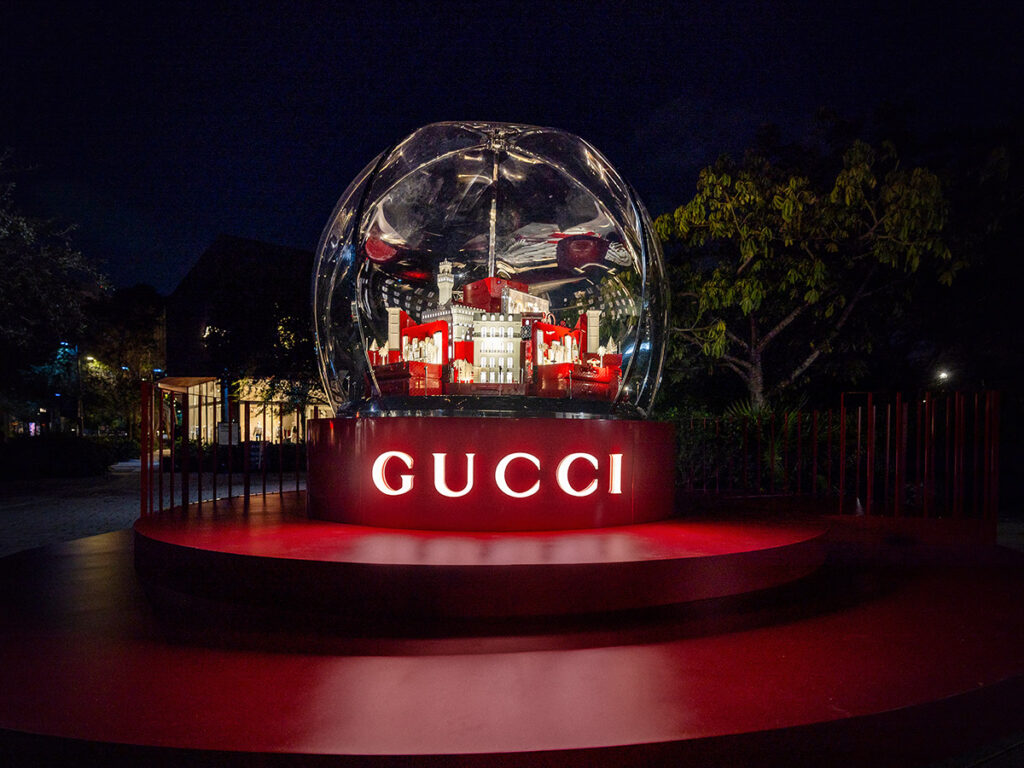
That aura has become a canvas for luxury brands. During last year’s edition, Bottega Veneta unveiled an installation of animal-shaped leather poufs — sculptural, tactile, unmistakably Bottega — arranged in a minimalist space where visitors weren’t allowed to sit. The message was clear: look, don’t touch.
But “untouchable” is a relative term in Miami. By the end of the week, half the city had selfies seated on those same poufs. That’s the paradox of Art Basel here — exclusivity invites participation, and the boundary between audience and brand is gloriously porous.
Sandra and I wandered from there into the work of Vanessa Raw — a British painter whose first U.S. solo exhibition, This Is How the Light Gets In, opened at the Rubell Museum during Art Week. We arrived just as her lush, Eden-like canvases debuted, and by 11 a.m., we heard that every piece had sold. It wasn’t just a sale; it was an atmosphere — the collective thrill of art and commerce colliding in real time.
The Miami Effect
Why Miami? Because the city gives something the traditional art capitals can’t: attitude. Art Basel Miami doesn’t feel like a staid auction house; it feels like a cultural happening. Sunset interludes, collectors chatting with DJs, design icons mingling with entrepreneurs — the fair leaks into the city’s bloodstream.
Miami’s own brand has evolved in parallel. Once “party city,” now “global creative capital for one week a year.” The city embraces it wholeheartedly — with governments, hoteliers, and brands working in sync to stage a week that’s equal parts exhibition, experiment, and economic engine.
Reflections for Brand Strategists
For marketers and strategists, Basel week offers three takeaways:
- Integration over sponsorship. Brands here don’t just attach logos — they participate in the narrative.
- Presence equals proximity. Being there, among the actors, opens doors that advertising can’t.
- Context is content. The backdrop — Miami’s color, sound, and rhythm — becomes part of the story.
Art Basel Miami Beach isn’t merely about viewing art. It’s about existing inside it — for a moment, for a week, for a brand. It’s about seeing and being seen, about how cities become stories and stories become currency.
For one week each December, Miami isn’t just the host — it is the brand.